Dialogic Change Model

Navigate Complex Change Through Structured Dialogue

Solutions for sustainability challenges require actors from different sectors to come together and agree on how they will collaborate. Yet even when courage and passion are strong, the success of multi-stakeholder collaboration depends on the quality of the process. Traditional project management focuses heavily on structure while neglecting the crucial human dimension of how people actually work together. The quality of dialogue between stakeholders often determines whether collaboration delivers results or stalls in endless discussions.

The Dialogic Change Model provides a practical methodology for navigating this challenge. It offers result-oriented, structured planning and implementation of multi-stakeholder collaboration through four iterative phases. The model helps actors frame fruitful dialogue settings, create supporting structures, and move from verbal commitments to concrete results.

"To improve is to change; to be perfect is to change often."

Winston Churchill

What the Dialogic Change Model Offers

The Dialogic Change Model is a practical guide for structured planning and implementation of collaborative change. It provides the basis for developing process architectures that support stakeholders to operate as a coherent collaboration ecosystem.

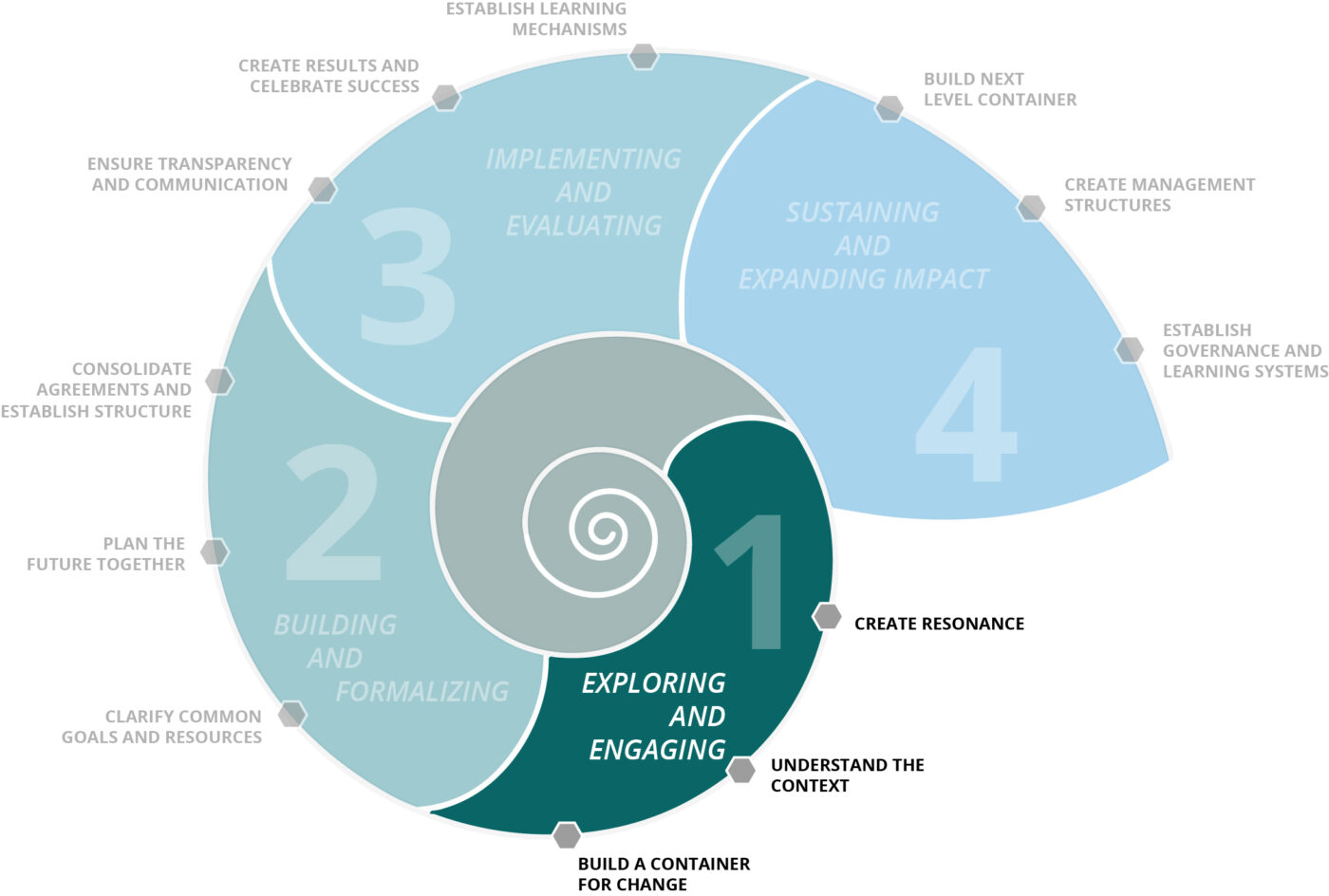
Distinguishing between four phases has proven helpful in taking all demands and requirements of different stages into account. Each phase builds upon the previous one, and the phases are iterative. Stakeholders can return to earlier stages if they get stuck, refining their approach based on learning.

The guiding principles are based on Dialogic Practices of voice, listen, respect, and suspend. By using structured dialogue to create space for collective intelligence, the model facilitates process architecture that can be owned by all stakeholders.

Three Key Elements

Building Collaboration Ecosystems
The model helps build collaboration ecosystems that can deliver by ensuring all demands and requirements of different stages receive adequate attention.

Enacting Collective Leadership
Paying attention to the Collective Leadership Compass dimensions throughout all DCM phases enhances collaboration quality and leads to better, more sustainable outcomes.

Process Monitoring Through Collaboration Catalysts
The six Collaboration Catalysts mirror the enhanced Compass dimensions and indicate a collaboration ecosystem that can deliver results. They help maintain and improve collaboration quality during implementation.

The Origin Story

The Dialogic Change Model emerged from practice. While supporting the Common Code for the Coffee Community (4C), Dr. Petra Kuenkel identified factors that make cooperation projects successful. She observed that traditional project management was too top-heavy on structure while neglecting the quality of dialogue between stakeholders. Over years of documentation, she developed a model that balances dialogue and collective intelligence with result-oriented process design.

CLI has since supported more than 40 collaborative change projects for SDG implementation and trained over 4,000 change agents. Through systematic observation, CLI discovered that dysfunctional collaboration patterns such as lingering mistrust, lack of ownership, or all talk no action symptoms always severely compromised results. Building human competencies for collaboration around the Collective Leadership Compass within the four DCM phases proved to be the single most important factor for successful change.

When to Use the Dialogic Change Model

The DCM applies to any change process requiring collaboration among different stakeholders. It is particularly valuable when:

  • Multiple sectors need to work together on shared challenges
  • Stakeholders have different interests, viewpoints, and competences
  • Building trust and commitment among diverse actors is essential
  • Results need collective action rather than hierarchical control
  • Long-term sustainability requires broad ownership

The model balances dialogue and collective intelligence with result-oriented process design, recognizing that the quality of relationships among stakeholders often determines success.

The Four DCM Phases

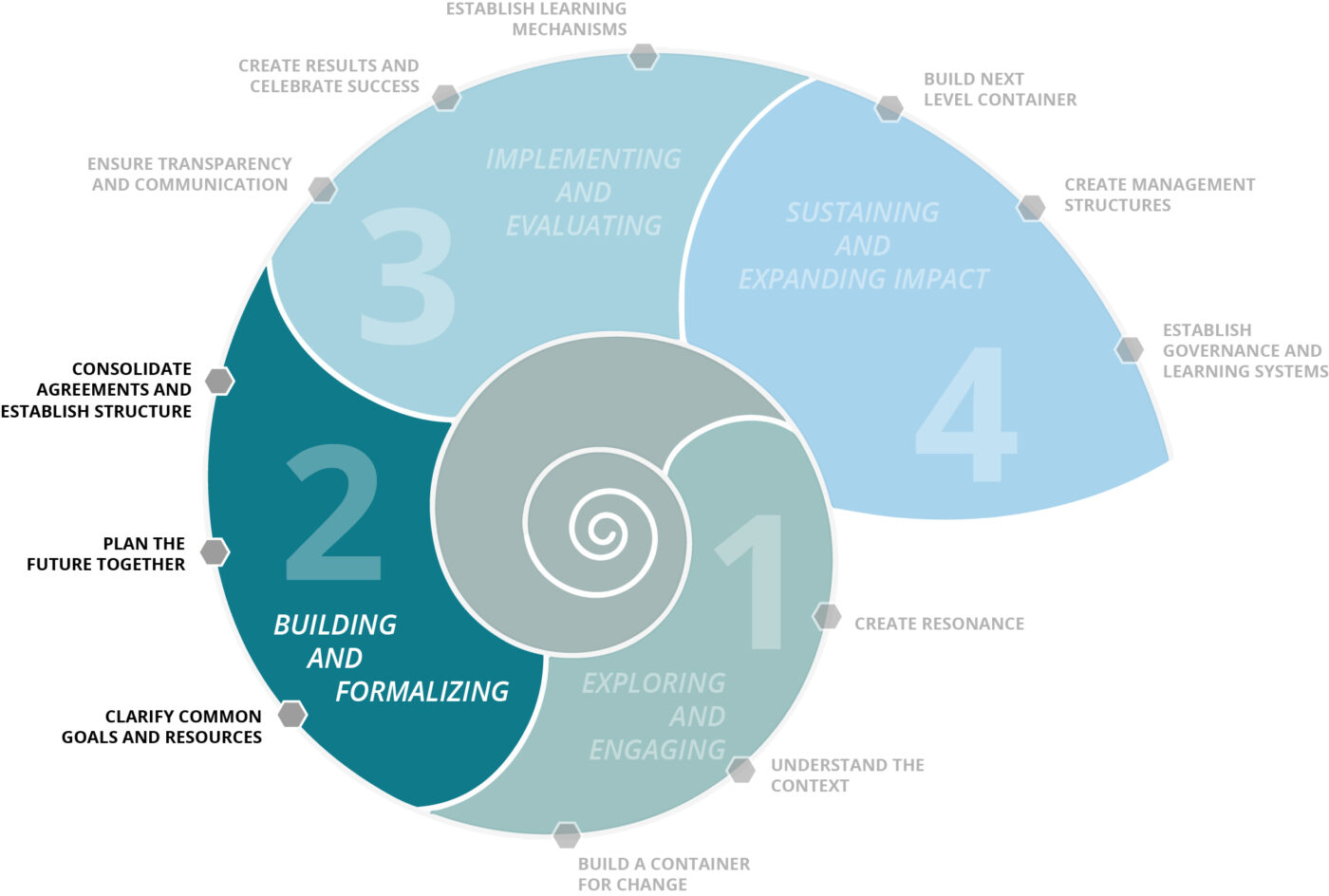
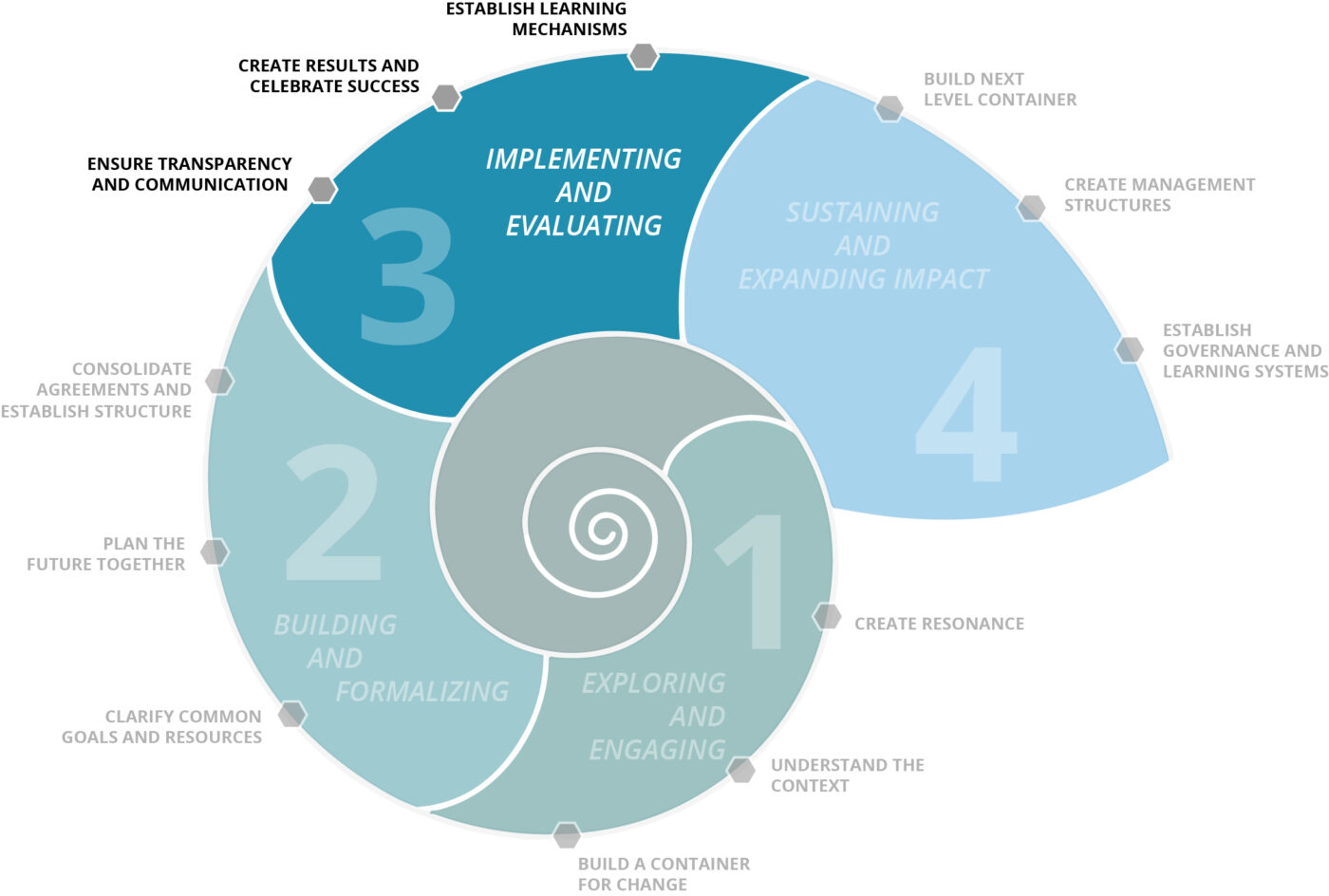
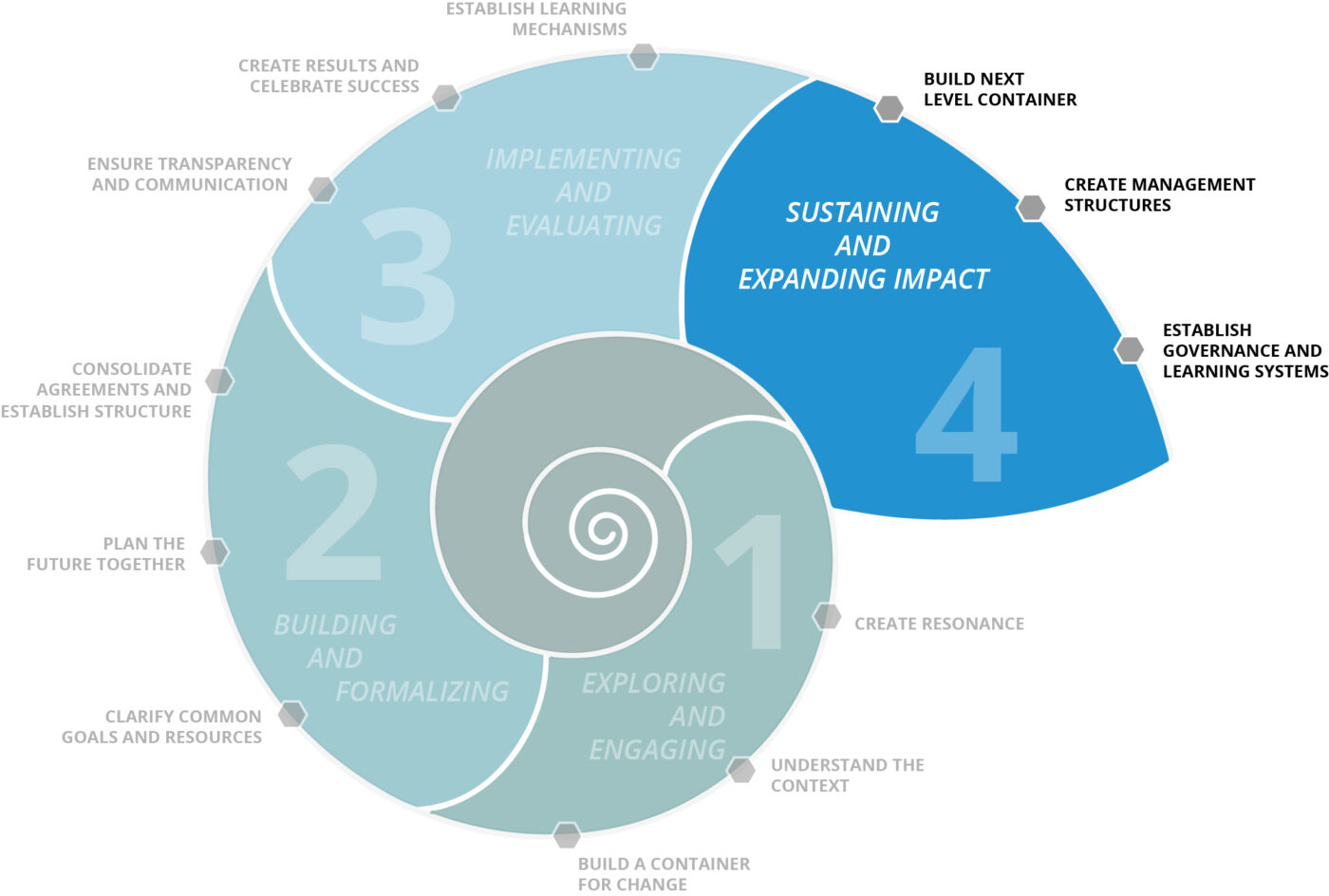
The Dialogic Change Model guides collaborative change through four iterative phases. While they build upon each other, the process is not strictly linear. Stakeholders may need to circle back to earlier phases as new challenges emerge or understanding deepens.

A detailed look at each DCM phase

If you want to learn more about each phase, please click below.

Phase 1

Phase 1: Exploring and Engaging

Phase 1 focuses on raising energy for collaborative change and dialogue. This is the foundation upon which everything else builds.

Creating Resonance and Building the Case for Change

Stakeholders explore the context, existing initiatives, and people involved. This requires understanding external factors that will influence the dialogue and dynamics of the complex system. Informal conversations with relevant stakeholders and opinion leaders help clarify prospects and potential obstacles.

A small cross-sector team, called the Container, meets to exchange ideas and receive inputs from interested people. The Container serves as the core group holding the intention for change, creating the foundation for what follows.

Expected Results of Phase 1:

  • Trust among key stakeholders
  • Explicit resonance for the initiative
  • Credibility for implementation
  • Participating stakeholders identified
  • Context and external factors explored
Phase 2

Phase 2 consolidates the system of stakeholder collaboration and formalizes commitment to change.

Plan the Future Together

Initial structures are developed, project teams defined, and regular meetings planned. This phase clarifies common goals and resources needed. It leads to agreements such as contracts, Memoranda of Understanding, project plans, or public addresses. With an official event and written document, the stakeholder dialogue officially comes to life.

The structure needs to offer process safety in an unpredictable environment. Contribution, roles, work allocation, and communication processes need joint agreement. Strengthening the Container while building broader commitment creates capacity for learning and problem-solving.

Expected Results of Phase 2:

Anything that shows commitment and gives structure to move forward:

  • Recommendation and clarity on stakeholder dialogue use
  • Agreements to collaborate
  • Project or activity plans
  • Implementation procedures
  • Formal steering structures (committees, working groups, etc.)
Phase 3

Phase 3 is the actual implementation of planned activities, including establishment of monitoring systems to ensure results and learning.

Ensure Transparency and Communication

Result orientation is key. Stakeholders must perceive visible change during the process, otherwise they might lose interest. It helps to concentrate on easily achievable results at the beginning. The goal of Phase 3 is to show that change is possible.

The degree of joint implementation and opportunity for joint review are decisive factors. If implementation is complex, a secretariat or support team can assist with coordination and monitoring. Regular reflection on the initiative and ongoing process is essential. Sometimes returning to Phase 1 approaches helps clarify context or integrate new stakeholders. Phase 3 can take months or years.

Navigating Complexity and Crisis

Complexity often becomes evident during this phase, sometimes as crisis. Symptoms may include external criticism, new unspoken interests emerging, negative press, endless discussions, or actors threatening to withdraw. The more stability and trust created in Phases 1 and 2, the better such instability can be overcome.

Expected Results of Phase 3:

  • Showcases of success
  • Achieved milestones
  • Project implementation reports
  • Public communication and media coverage
  • Established monitoring systems
Phase 4

Once agreed-upon results are reached, the question remains whether to stop or further develop the initiative.

Create Management Structures

Many dialogues terminate successfully after Phase 3. If goals are achieved, success should be celebrated and contributions acknowledged. However, some may want to consolidate outcomes into sustainable structures by taking the endeavor to the next level, replicating it, integrating new issues, or further institutionalizing.

Phase 4 concentrates on building structures without losing sight of the crucial role of people and process. It begins by creating the next-level Container and integrating new participants who must quickly understand the initiative’s urgency and emotionally connect with the goal.

Transparency, stakeholder representation, dialogue, ownership, and outcome orientation must be reflected in institutionalization. The major challenge is keeping the spirit of change alive.

Managing the Transition

Transition from loosely structured initiative to institution requires professional management. Roles change and decision-making must become more efficient. The original core group should remain actively involved, progressively handing over functions to new actors.

Expected Results of Phase 4:

  • Extending the goal and stakeholder participation
  • Institutionalizing a successful dialogue form
  • Using experience in another process
Collaboration Catalysts for Process Monitoring

The six Collaboration Catalysts mirror the enhanced Compass dimensions and indicate a collaboration ecosystem that can deliver results. Process monitoring should be based on these indicators to maintain and improve collaboration quality. Rather than only tracking deliverables, monitoring Collaboration Catalysts ensures attention to the human and relational dimensions that determine whether results will be achieved and sustained.

Learn more about Collaboration Catalysts

Learn more about the Dialogic Change Model

CLI's basic intensive training on the DCM offers backgrounds on dialogic change and multi-stakeholder partnerships and applies it to your specific change project contexts.

Additional DCM material

The DCM in Context: Integration with Other CLI Methodologies

The Dialogic Change Model forms part of an integrated approach to building collaboration ecosystems for sustainability transformation.

Connection to the Collective Leadership Compass

The Compass and DCM work together powerfully. The DCM provides the process architecture showing what needs to happen in each phase, while the Compass provides the competency framework showing how stakeholders need to interact. Paying attention to the six Compass dimensions throughout all DCM phases enhances collaboration quality and leads to better outcomes.

Application in Transformation Stewardship

CLI’s Transformation Stewardship services combine the DCM with ongoing advisory support, capacity building, and coaching, helping stakeholders successfully apply the model in their specific contexts.

Frequently Asked Questions

Traditional project management is top-heavy on structure while neglecting dialogue quality between stakeholders. The DCM balances structure with attention to human dimensions of collaboration, recognizing that interaction quality among stakeholders often determines success.


Not necessarily. Many successful collaborations conclude after Phase 3 when goals are achieved. Phase 4 is for initiatives wanting to consolidate outcomes into sustainable structures or institutionalize at a more formal level.


The DCM acknowledges that crises often emerge during implementation. Returning to Phase 1 approaches to rebuild trust, clarify context, or integrate new stakeholders can help overcome impasses. Stronger foundations built in earlier phases enable better crisis navigation.

Yes. While developed for multi-stakeholder collaboration, its principles apply to any change process requiring coordination among diverse actors, including cross-functional teams or initiatives requiring broad internal buy-in.

The expected results for each phase provide guidance. Movement happens when key outcomes are achieved and stakeholders are ready for the next stage. This requires judgment and attention to collaboration quality, not just task completion.

Effective facilitation requires understanding the model, skill in dialogic practices (voice, listen, respect, suspend), ability to design appropriate processes for each phase, and awareness of the Collective Leadership Compass dimensions. CLI’s courses build these skills through experiential learning.

Getting Started with the DCM

For Individual Learning
Engage with reference materials and online guidance at compass-tool.net, or participate in CLI's open courses for structured learning with peers.

For Project Teams
Commission tailor-made training applying the DCM directly to specific collaboration challenges.

For Complex Initiatives
Engage CLI's Transformation Stewardship services for extended support combining capacity building with ongoing advisory throughout the change phases.

For Building Broader Capacity
Consider the certification track to become a Collective Leadership Specialist or Facilitator, gaining deep competence in both DCM and Compass methodologies.

The Path Forward

Multi-stakeholder collaboration for sustainability is not optional. The challenges facing humanity and the planet demand it. But collaboration doesn’t happen automatically. It requires skilled stewardship, structured processes, and attention to both technical and human dimensions of change.

The Dialogic Change Model provides a tested pathway for this work. Born from practice and refined through hundreds of applications worldwide, it offers guidance for the full journey from initial exploration through sustained impact. When combined with the Collective Leadership Compass and supported by skilled facilitation, the DCM helps diverse stakeholders move from verbal commitments to concrete results.

The quality of collaboration directly impacts outcomes. Dysfunctional patterns compromise results, while high-quality collaboration ecosystems deliver. The DCM helps build and maintain that quality, providing structure while honoring the ancient human knowledge of dialogue and collective intelligence.